
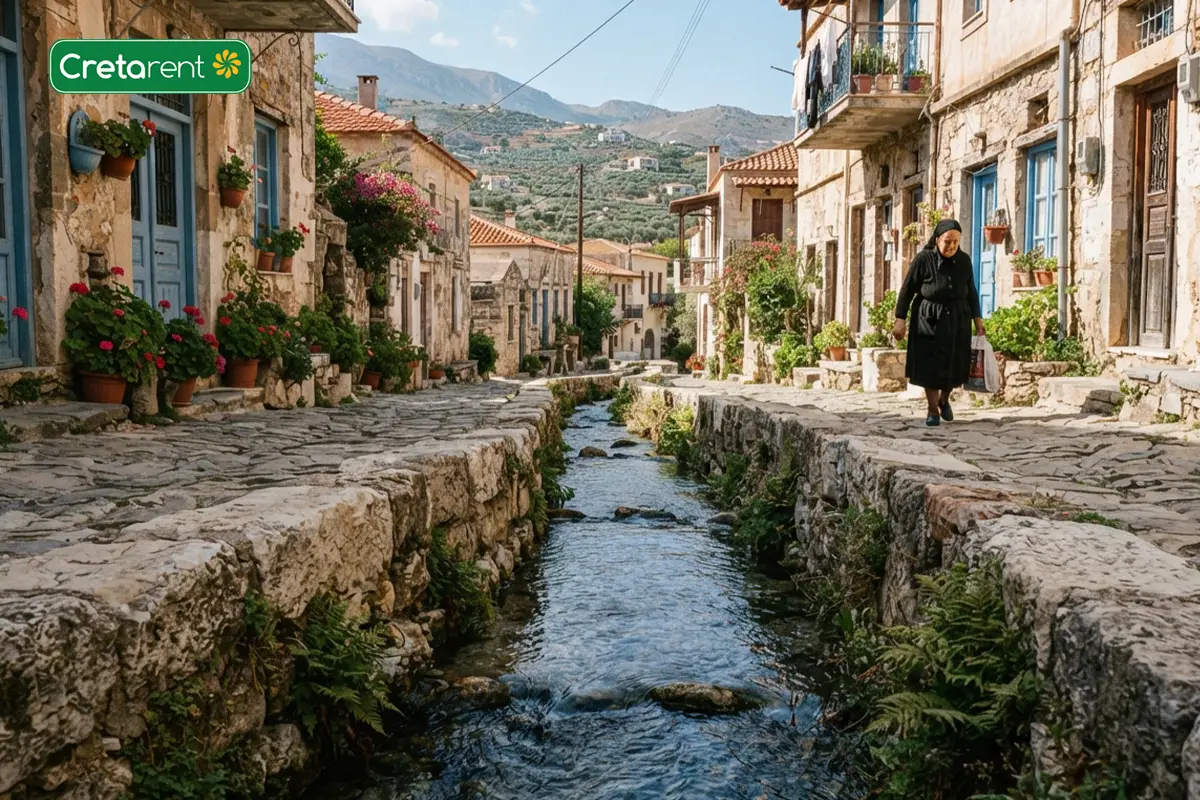
If you have spent a few days on the coast, driving inland to Zaros can feel like stepping into a different Crete.
The air is cooler, the landscape becomes greener and the pace changes. Instead of beaches and busy resort streets, you get a mountain village, running water, shady trees, a small lake and tavernas where trout is one of the local specialities.
Zaros sits on the southern slopes of Psiloritis, about 45 km from Heraklion, and is famous for its natural springs, Lake Votomos and the nearby Rouvas Gorge. You can certainly make the drive about hiking if you want to. But you don’t have to. For us, that’s part of what makes Zaros such a good day out.
Why does Zaros feel so different from the coast?
The first thing you’ll notice is the water.
Zaros is unusually green for this part of Crete because of the springs flowing down from Psiloritis. The water feeds the area around the village and Lake Votomos, creating a landscape of plane trees, vegetation and running water that feels very different from the dry countryside you may have driven through to get there.
That also makes Zaros particularly appealing during the warmer months. You aren’t escaping summer completely, of course. But sitting beside water and under trees at the foot of the mountain is a welcome change after a few days of hot coastal sightseeing.
Start at Lake Votomos
The small lake above the village is probably the best-known part of Zaros.
Lake Votomos is artificial, but don’t let that put you off. It is surrounded by lush vegetation, with ducks, fish, trees and paths around the water. More importantly, it feels like a natural place to slow down for an hour rather than another attraction you need to rush through.
You can walk around the lake, sit beside the water or have a coffee before deciding what you want to do next. There are tavernas around the lake as well, so this is one of those rare Cretan stops where the best plan may simply be to arrive hungry.
And if you’ve come from the coast in the middle of summer, the shade and cooler mountain air are part of the attraction.
Yes, you should probably try the trout
Zaros is particularly well known for its trout.
The local springs provide the water for trout farming, and the fish has become one of the area’s best-known dishes. Taverns around the lake serve trout alongside traditional Cretan food, making lunch one of the main reasons to make the trip rather than something you squeeze in between sightseeing stops.
If you’re expecting a huge mountain restaurant complex, you won’t find one. The appeal is much simpler: sit outside, order some local food, enjoy the shade and take your time.
This is also one of those places where it makes sense not to schedule your afternoon down to the minute. A walk around the lake followed by lunch can easily become a longer stop than you originally expected.
What if you want to walk?
This is where Zaros becomes much more interesting for people who want some nature without spending the whole day hiking.
The Rouvas Gorge starts near the lake and leads into the Rouvas Forest on the slopes of Psiloritis. The marked route passes through a narrow gorge with springs, shaded sections, rocky terrain and oak and cypress woodland. The full route towards the plateau takes around three hours, according to Visit Greece.
That’s a proper hike, so don’t treat it as a casual stroll after lunch.
If you aren’t prepared for a longer walk, you can simply enjoy the lake and surrounding area instead. You don’t have to complete the gorge to get something out of the day.
For anyone who does want to hike, comfortable footwear, water and sensible planning are important. Conditions in mountain areas can also change, so check locally before setting off.
The village itself is worth a little time
Don’t make the mistake of treating Zaros as just the car park for the lake. The village has traditional streets, churches and older buildings, and its history is closely connected with the water and agriculture of the area. A Roman aqueduct is also among the historical remains associated with Zaros.
Take a walk through the village after lunch rather than immediately getting back in the car.
This is where Zaros feels different from a sightseeing destination. You see a working Cretan village rather than a place built entirely around visitors. There are cafés and tavernas, locals going about their day and plenty of reasons to stop for another coffee.
You can add a little history to the drive
If you want to make the day longer, the area around Zaros has several historical places that can be combined with the visit.
The Vrontisi Monastery, for example, is nearby and has a long history dating back centuries. Other monasteries and historic sites can also be found around the southern slopes of Psiloritis.
You don’t need to turn the day into a tour of every monument in the area. One additional stop is enough.
Zaros works best when you give yourself time to enjoy the contrast between the mountain, the water, the food and the village rather than trying to collect attractions.
Is Zaros worth visiting in summer?
Yes, and summer is actually one of the times when the difference between Zaros and the coast becomes most noticeable.
The southern slopes of Psiloritis can be hot, but the abundant water and vegetation around Zaros create a much greener and more shaded environment than many other inland areas. Visit Greece specifically highlights the coolness of the mountain and the shaded landscape around the lake and Rouvas Forest.
That makes Zaros a useful option when you have had enough of the beach.
You could spend the morning somewhere on the coast, drive inland, have lunch by the lake and spend the afternoon around the village. Or make Zaros the main destination and take your time from the start.
Either way, you don’t need to arrive at 8am to enjoy it.
How long should you spend in Zaros?
For a relaxed visit, allow several hours rather than trying to squeeze Zaros into a quick stop.
A simple day could look like this:
Drive from Heraklion → Zaros village → Lake Votomos → walk around the lake → lunch → village walk → optional monastery or short nature walk → return.
If you’re planning the full Rouvas Gorge hike, treat that as a different kind of day. The route is substantially longer and requires proper preparation.
The beauty of having a car is that you can decide which version of Zaros suits you.
Maybe you want a proper walk or maybe you want lunch under the trees. Maybe you simply want somewhere cooler for a few hours. You don’t have to decide until you get there.
Is the drive from Heraklion worth it?
For us, yes. Lake Zaros is a roughly 50 minutes from Heraklion, using the Heraklion–Tympaki road and local roads. That’s a manageable drive for a day trip, especially when the destination feels so different from the city and coast you have just left behind.
And this is exactly the sort of place where having a rental car changes the experience.
You aren’t visiting Zaros because it happens to be on a bus route between two major attractions. You are going because you decided that a mountain village, a lake and a long lunch sounded like a good way to spend the day.
That’s a pretty good reason to drive.
Zaros is not about ticking off attractions
You could visit the lake, walk through the gorge, see a monastery, explore the village and have lunch. Or you could do two of those things.
The point isn’t to fit everything in.
Zaros is one of those places that works precisely because it gives you permission to slow down. Sit under the trees. Walk beside the water. Eat something local. Have another coffee before heading back.
After several days of beaches and busy coastal towns, that change of pace can be exactly what you need. And when you eventually drive back towards the coast, you’ll probably notice something else: Crete feels considerably bigger once you’ve started exploring the mountains.
Continue Exploring Crete
If you’re looking for more ideas away from the coast, you may also enjoy: