
Local Guide • 6 min read
One of the most common questions we hear towards the end of summer is surprisingly difficult to answer with a date:
When does the season actually end in Crete?
There isn’t really a single day when the island suddenly switches from summer to winter. September can still feel very much like summer, October can be surprisingly warm, and some businesses stay open well into autumn while others start winding down earlier.
The bigger change is gradual. The island gets quieter, some seasonal businesses reduce their hours or close, and the pace becomes a little slower. So if you’re thinking about visiting Crete outside the busiest summer months, here’s what you can realistically expect.
September is still very much part of the season
If you’re visiting in September, you don’t need to worry that you’ve arrived after everything has closed. The main tourist areas are still active, beaches are still being used, restaurants are still serving visitors and there is plenty going on.
In fact, early September can feel surprisingly similar to August. The biggest difference tends to become noticeable as the month progresses. By the second half of September, some places are quieter and you may start noticing fewer people on the roads and beaches. But Crete is certainly not “closed for the season.”
This is one reason September is such a comfortable time to visit. You still get most of the summer experience without quite the same intensity.
So what happens in October?
October is where things become more variable. Some seasonal businesses continue operating, particularly in areas that depend heavily on tourism. Others start reducing their opening days or close for the year.
The official regional tourism information gives a good idea of how varied this can be. Some restaurants and tavernas listed by Incredible Crete operate through October, while others are open all year or have more limited seasonal schedules. For example, several listed businesses operate until 30 or 31 October. That means you shouldn’t think of October as “everything is closed.” It’s more accurate to think of it as a transition period.
A beach bar that was open every day in August might now open only on good-weather days. A seasonal restaurant may decide to close earlier than usual. Another family-run taverna may continue operating throughout the winter.
There is no single rule for the whole island.
Hotels don’t all close at the same time either
This is particularly important if you’re staying in a resort area. Some large seasonal hotels operate for much of the year, while smaller properties may finish their season earlier. The exact timing depends on the property and the location.
If you’re travelling in October, it’s worth checking your accommodation’s operating dates rather than assuming that a whole resort is either “open” or “closed.” The same applies to restaurants and other businesses nearby.
A town with plenty of year-round residents will naturally have more options outside the summer season than a small resort whose businesses depend almost entirely on holidaymakers.
What about restaurants and tavernas?
This is probably one of the things visitors worry about most. The good news is that you can still eat very well in Crete after the height of summer. Many traditional tavernas are not purely seasonal businesses. Some operate throughout the year, particularly in towns and villages where local residents provide their main customer base.
The regional tourism directory, for example, includes Cretan restaurants and tavernas listed as operating all year, alongside others that run through October or have different seasonal schedules. This is actually one of the reasons we like travelling outside peak summer.
Instead of choosing between dozens of restaurants in a busy resort, you can find yourself sitting in a village taverna with mostly local customers, enjoying a long lunch without the feeling that you need to hurry. Just check opening days if you’re driving somewhere specifically for dinner, particularly later in October.
Do attractions close after summer?
Not necessarily. Many archaeological sites, museums and attractions continue operating in autumn, although opening hours can change as the season progresses.
The Natural History Museum of Crete in Heraklion, for example, lists its summer schedule through 31 October and a different winter schedule from 1 November.
The same pattern can be seen elsewhere. Visit Greece lists Ancient Itanos and the Vai Palm Forest area with operating information that distinguishes between the summer period ending 31 October and the winter period beginning 1 November.
So if you’re visiting in October, don’t assume that an attraction is closed just because the summer crowds have disappeared. Check the current opening hours before you go.
The beaches don’t close
Obviously, the sea doesn’t know when the tourist season ends. And neither do the beaches.
During early autumn, you can still have proper beach days, particularly when the weather is warm and settled. The main difference is that you may find fewer organised services around the beach. Some beach bars, watersports operations and seasonal facilities may have reduced hours or finish for the year.
That doesn’t make the beach itself any less enjoyable. In fact, this can be one of the nicest things about visiting outside peak summer. You can arrive at a beautiful stretch of coast and find that there is considerably more space around you.
Just don’t expect every beach to have exactly the same facilities it had in August.
The countryside has its own autumn season
There’s another side of the season that you might not notice if you’re only thinking about beaches. Autumn is an important time in the Cretan countryside.
The grape harvest takes place during September, traditionally known as “Trygitis,” and autumn also brings the season of rakokazana, when communities gather around the production of tsikoudia. The regional ecotourism site highlights both as part of the island’s autumn traditions.
This is one reason we wouldn’t describe autumn in Crete simply as “the end of the tourist season.” For some parts of the island, it’s the beginning of a completely different season. Villages become interesting for reasons that have nothing to do with sun loungers and beach bars.
When does Crete actually become quiet?
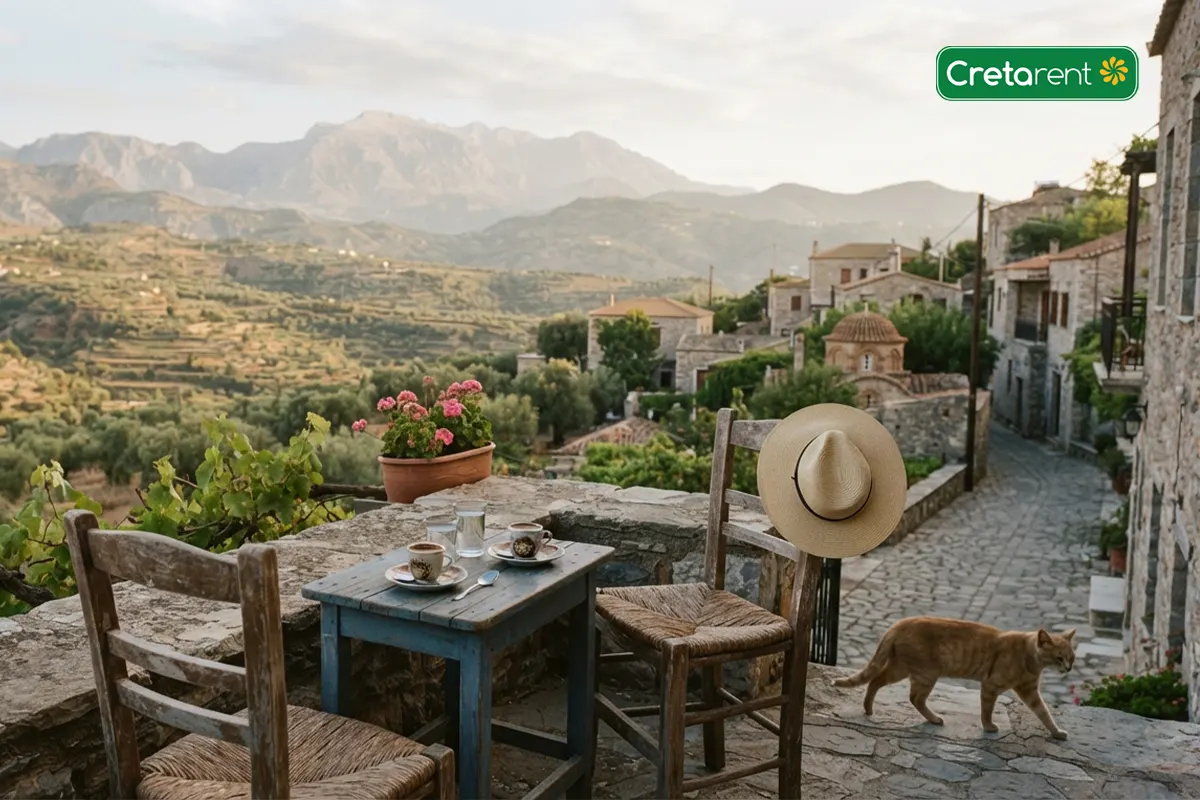
If your idea of “quiet” means empty beaches and very few tourists, you’re more likely to notice it in October than in September. But even then, it depends enormously on where you are.
Heraklion and Chania remain working cities all year. Villages have residents all year. Restaurants serving local customers continue operating. Roads don’t suddenly become empty. What disappears first is the holiday atmosphere created by peak summer tourism.
The big resort hotels gradually empty. Seasonal beach businesses close. Some excursions stop running every day. There are fewer organised groups around the major attractions. The island itself doesn’t disappear. It simply becomes less focused on visitors.
Is late October too late for a Crete holiday?
Not necessarily. If your priority is guaranteed hot beach weather every day, late October is obviously more of a gamble than July or August. But if you’re interested in villages, food, archaeology, walking, road trips and seeing a quieter side of Crete, it can be a very interesting time to come.
You just need to plan a little differently. Check the weather. Check opening days. Don’t assume every seasonal business will still be operating. And if there’s somewhere specific you really want to visit, confirm that it’s open before driving across the island.
The reward is that you can experience Crete at a much slower pace.
And what about renting a car?
This is actually one period when having a car can be particularly useful. During peak summer, public transport and organised excursions give you plenty of ways to move around the main tourist areas. As the season winds down, some seasonal services may become less frequent.
With your own car, you don’t have to base your plans around what is still running. You can drive from Heraklion into the countryside, stop in a village for lunch, continue towards the coast and head back when you’re ready.
And because you’re no longer trying to fit around the busiest summer traffic, the journey itself can be much more relaxed.
So, when does the season end in Crete?
There isn’t a specific date.
September is still firmly within the tourist season.
October is the transition period.
By late October, you’ll notice considerably more seasonal businesses winding down, but many hotels, restaurants, attractions and services are still operating, while year-round businesses continue as normal.
And once November arrives, the island is clearly in its quieter period. But that doesn’t mean there’s nothing to do. It simply means you’re experiencing a different Crete. The beaches are still there. The villages are still there. The mountains are still there. And the tavernas haven’t forgotten how to cook just because summer is over.
In some ways, that’s when the island becomes even more interesting.
Continue Exploring Crete