
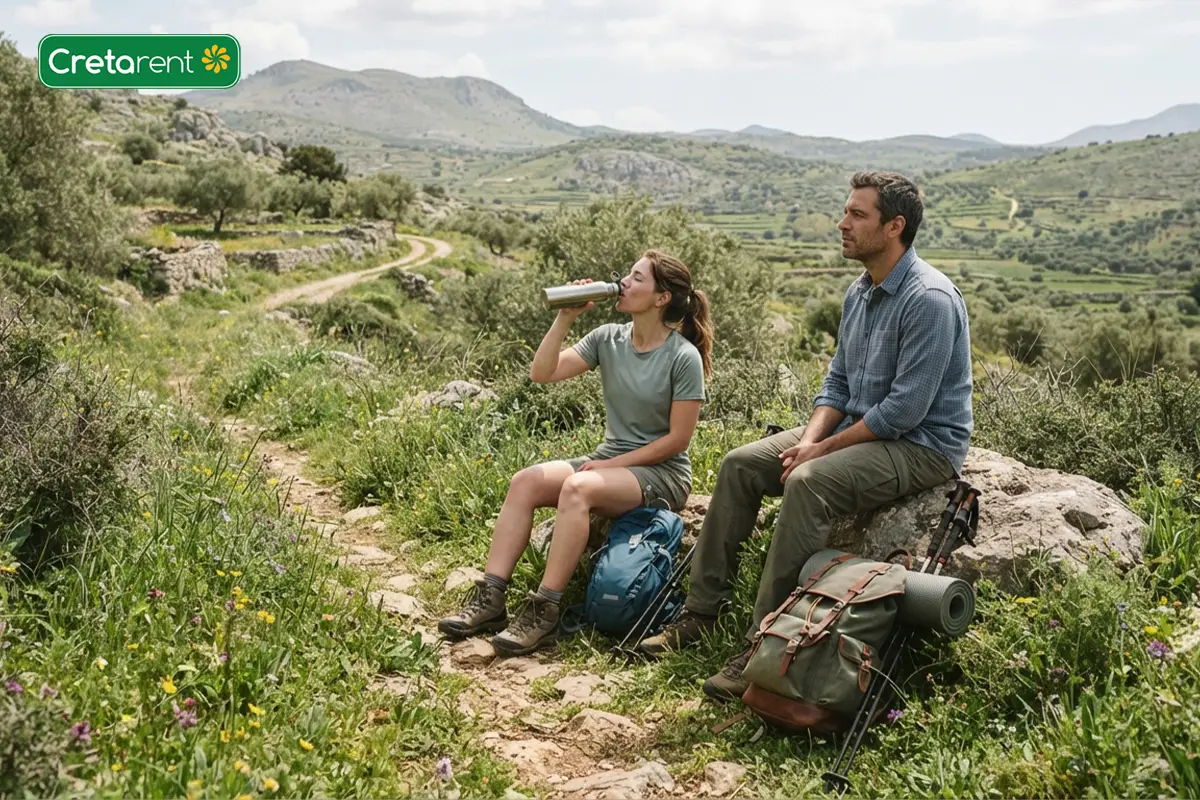
There is a point in the year when Crete starts to feel different. The temperatures drop a little, the afternoons become easier, and suddenly you can spend a whole day outside without thinking about how to escape the heat.
This is when Crete becomes especially interesting for exploring.
The beach can still be part of the trip, but you have more options. You can walk through a village in the middle of the afternoon, take a mountain road, visit an archaeological site, go for a hike or simply spend longer outside without planning your day around the hottest hours.
Crete’s mild Mediterranean climate means the change is gradual rather than dramatic, and the island’s official tourism site describes autumn as its mildest season. Mountain areas are cooler than the coast, while southern and eastern parts of the island generally remain warmer.
Start looking inland
When summer temperatures are high, it is easy to spend most of your holiday along the coast. Once the weather cools down, inland Crete becomes much more inviting.
A drive through the countryside can take you past olive groves, vineyards, old villages and mountain slopes without the feeling that you need to reach the sea as quickly as possible.
The villages of Apokoronas in western Crete are a good example. Places such as Vamos, Fres and Gavalochori combine traditional houses, village squares, cafés and surrounding countryside, with roads connecting them that are enjoyable to explore by car.
You don’t necessarily need a major attraction at the end of the road. The village itself can be the reason for going.
Go for a proper walk
Cooler weather changes how you experience Crete on foot. In summer, even a relatively short walk can become uncomfortable once the sun is high. Later in the year, you can spend much longer outdoors, making it a better time to explore paths through the countryside, mountain villages and gorges.
Autumn, from late September to mid-November, is among the best periods for hiking because of the milder temperatures. However, you don’t have to turn the trip into a serious hiking holiday. A short trail followed by lunch in a village can make a very good day.
For longer or more remote routes, though, check local conditions before setting off. Mountain weather can change quickly, and some trails are much more demanding than they appear from the road.
Explore the mountains without rushing
Crete’s mountains are not just for experienced hikers. You can drive into the foothills, stop at a village, walk around for an hour and continue somewhere else. When the temperature is more comfortable, the landscape becomes something you can actually spend time in rather than something you admire through the car window.
The Psiloritis area is particularly rich in possibilities, with mountain villages, archaeological sites, caves and walking routes spread across the region.
The Asterousia Mountains offer a completely different landscape further south of Heraklion. They stretch between Psiloritis and the Libyan Sea, with villages, monasteries, gorges and steep coastal scenery. These are the kinds of places that make much more sense when you aren’t trying to avoid the midday heat.
Take a road trip without making the beach the destination
One of the nicest things about cooler weather is that a road trip doesn’t need a specific purpose. You can leave Heraklion in the morning and simply head inland. Stop for coffee, find a village you’ve never visited, have lunch somewhere local and take a different road back.
Crete is particularly well suited to this because the scenery changes quickly. The official tourism information describes the island as having a combination of mountains, gorges, coastline and countryside, with each route offering different landscapes.
This is also where having a car becomes useful. You’re not limited to places directly connected by the main bus routes, and you can change your plans when you see something worth stopping for.
Visit places that are uncomfortable in summer
Some of Crete’s most interesting places are much easier to appreciate once the heat drops.
Archaeological sites are an obvious example. Walking around ancient ruins under strong summer sun can be tiring, especially if there is little shade. Cooler weather gives you more time to actually look around rather than searching for the next shaded spot.
The same applies to old villages, monasteries and historic sites. Crete has layers of Minoan, Greek, Roman, Venetian and Ottoman history, and many of these places are spread across the countryside rather than concentrated in the main cities.
You can make a whole day around them instead of treating them as a quick stop between beach visits.
Look for the quieter side of Crete
The change in atmosphere is another reason to explore outside the main resorts.
As summer fades, the island gradually becomes less focused on visitors. You start seeing more of everyday Crete: people sitting at the kafeneio, farmers working in the fields, children coming home from school and locals meeting for coffee.
That doesn’t mean everything closes down. Crete is a year-round destination, and its official tourism organisation specifically promotes the island outside the main summer season for its mountains, gorges, paths and natural landscapes.
You simply experience the island differently.
There is still plenty of time for the sea
Cooling weather doesn’t mean you have to forget about swimming.
September can still feel very much like summer, and even later in the season you may have warm, sunny days. The difference is that you no longer need to spend every day on the beach to make the most of the weather.
A good autumn day might involve a morning swim, lunch inland and an afternoon drive through the countryside.
Southern Crete can be particularly interesting for this mix of activities. Around Ierapetra, for example, beaches sit alongside villages, gorges, agricultural landscapes and mountains, giving you plenty of alternatives when you want a break from the coast.
Don’t plan every hour
This is probably the biggest change of all. When the weather is cooler, there is less pressure to organise your day around sunrise, midday heat and the evening beach.
You can leave later, stop for coffee, then stay for lunch.
You can walk around a village without checking the time every ten minutes.
And if you find a road that looks interesting, you can take it.
That kind of flexibility is one of the best reasons to explore Crete by car outside the height of summer. The destination doesn’t always need to be the most important part of the day.
Where would we go?
If you are staying around Heraklion, we’d use the cooler weather as an excuse to explore in different directions. Head inland for villages and countryside. Go towards the Psiloritis foothills when you want mountains. Drive south when you want a completely different landscape around the Libyan Sea. Choose a short walk or gorge when you want to spend more time outdoors.
And keep some time for places you’ve already heard of but perhaps avoided during the hottest months. Crete is a large island with more than 1,000 kilometres of coastline and a huge variety of landscapes, so there is no reason for your trip to revolve around one type of scenery.
Cooler weather can make a better holiday
Summer has its place. If you want long beach days and warm evenings, it is hard to beat. But once the temperatures become more comfortable, Crete becomes easier to explore properly. You can walk more, drive further, spend time in villages, visit archaeological sites and get into the mountains without feeling that you’re fighting the heat.
That is when the island starts to feel less like somewhere you came to spend time beside the sea and more like somewhere you came to discover.
Continue Exploring Crete